
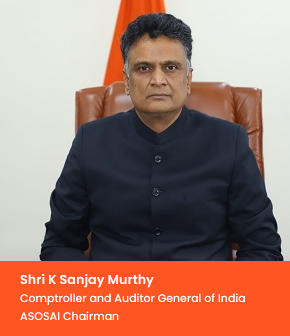
From the desk of ASOSAI Chair
Comptroller and Auditor General of India ASOSAI Chairman
Dear Members of the INTOSAI and ASOSAI Community,
It is my privilege to address you through the April 2026 edition of the ASOSAI Journal. The theme chosen for this issue, ‘Strengthening Public Sector Accountability through Integrated and Cross-cutting Audits,’ is topical and relevant as Governments are increasingly embracing whole of government approach to deliver services to beneficiaries with greater efficiency and effectiveness.
Public sector accountability is the cornerstone of democratic governance. As Supreme Audit Institutions (SAIs), our constitutional and statutory mandates empower us to ensure that public resources are managed with integrity and aligned with legislative intent. However, the conventional audit of individual departments in isolation is no longer adequate to capture the complexity and interdependence of modern governmental programmes. Today’s development initiatives are inherently multi-dimensional, operating across vertical hierarchies—from national to local levels—and horizontal networks spanning multiple ministries and sectors.
To remain relevant and effective, SAIs must transcend the limitations of a siloed approach and embrace an integrated, cross-cutting audit framework. By placing the program or policy outcome at the center of our analysis, we can identify coordination gaps, systemic inefficiencies, and duplication of efforts that traditional oversight might overlook. This holistic approach allows us to evaluate the tangible impact of public service delivery on the well-being of citizens, ultimately answering the fundamental question of whether government policies are achieving the outcomes they were designed to deliver.
SAI India has recently embraced this evolution through thematic audits relating to Micro, Small and Medium Enterprises (MSME) development, multi-modal logistics and simultaneous audit of social-sector schemes, where the seamless coordination of utilities, regulatory bodies, and multiple ministries is not merely desirable but essential for programme success. Such audits leverage advanced data analytics and interdisciplinary collaboration to provide a strategic perspective on governance that goes beyond mere transaction-testing, enabling SAIs to serve as genuine partners in evidence-based governance reform.
I am confident that the insights shared in this issue will serve as a valuable reference and a source of inspiration for member SAIs as we strive to institutionalize these integrated practices. By strengthening inter-departmental accountability and fostering a results-oriented audit culture, we can deepen public trust, strengthen legislative oversight, and meaningfully contribute to evidence-based decision-making across the ASOSAI region and beyond.
I extend my sincere appreciation to all the contributors for their thought-provoking articles and to the member SAIs for their steadfast commitment to our shared mission of promoting accountability, transparency, and good governance in the public interest.
With my best wishes,
Shri K Sanjay Murthy
Comptroller & Auditor General of India and Chairman, ASOSAI