Dr. Ahmed Obaid Abdullah Toqan
Assistant Chief of staff Audit, SAI Iraq

Asian Journal of Government Audit
Dr. Ahmed Obaid Abdullah Toqan
Assistant Chief of staff Audit, SAI Iraq
The Holy Qur’an confirms that every human being and entity has a value and a role in this worldly life, Where man was created in the best stature and granted dignity, Therefore, all people and things have had a value since the beginning of creation, but these values vary from one person to another and from one thing to another.
This difference may be natural because difference is prevalent in our world.
Basedon the above, things differ in their value and the extent of their benefit, Since these things have a monetary or in-kind cost, Here, it is necessary to know the extent of its benefit before obtaining it and paying its price, Here it is the idea of research came that the value we get from these things in exchange for the money we pay to buy them.
The article aims to understand value for money from a theoretical perspective and discuss the impact it can have and how to benefit from it.
The practical aspect of the research included examining the practical aspects of numerous research papers, theses, dissertations, and websites, taking practical cases that demonstrate the reality of value for money and discussing them from a scientific perspective.
This worksheet expounds on the principle of value for money (VFM) and its conceptually straightforward and relevance It also introduces ‘four Es’ framework economy, efficiency, effectiveness and equity – is also frequently used to think about different aspects of VfM and Value for money assessment methods and their practical applications and Real-life examples to determine what value for money is, The article aims to understand value for money from a theoretical perspective and discuss the impact it can have and how to benefit from it, To achieve this goal, methods for assessing value for money and their practical applications were researched, and real-life examples were used to determine the value of money, The article reached a set of conclusions such as: Ensuring that a policy or project provides value for money is common sense, particularly at a time of stretched budgets. Yet proving VfM in theory-based evaluations is anything but simple. Benefits can be hard to measure and value; the impact of interventions can be difficult to disentangle in complex, long-running programmes; and the risk of double counting is ever present, and recommendations like: There are benefits and limitations to each of the methods of assessing value for money. It is important for the evaluator to consider a range of options for determining whether an activity is value for money. They should think through the benefits and limitations of each approach and ensure key points are included in the design of the evaluation that may be important. It may be necessary for the evaluator to source input from other specialist consultants in particularly complex evaluations of this nature.
The term Value for Money (VfM) describes general principles governing good planning, procurement and management. A key concept is that in order to judge whether an intervention was worthwhile, the money spent needs to be assessed alongside what has been delivered or achieved. VfM analysis can be conducted in many ways. It can be used during planning and design, or for monitoring and evaluation (M&E) (Vera Scholz;2020).
The concept of Value for Money (VfM) in appraisal and evaluation is straightforward. VfM is concerned with the good use of public funds and with demonstrating the relationship between the costs and benefits of an intervention – whether a policy, a project or a programme. It is an important tool for the accountability of public spending.
VfM is concerned with the optimal use of public funding and is a critical tool for the accountability of public spending. (Treasury Green Book ,HM Treasury;2022),
VfM is not about minimising cost. The focus is the relationship between costs and benefits – ‘bang for the buck’ – to get the most out of public spending. The benefits assessment is holistic, taking into account social as well as economic benefits. As the Green Book puts it (Frontier;2022):
“Value for Money… is a judgment about the optimal use of public resources to achieve stated objectives … based on consideration of … present value to society of all social, economic and environmental benefits – these may be qualitative or quantitative – [and] … present public resource costs.”
A key theme in contemporary performance management is that organisations need to measure, and manage, non-financial aspects of performance, rather than focusing solely on financial aspects. However, in profit-seeking organisations, there remains an underlying financial objective: typically, to maximise profit in order to maximise value for shareholders (ACCA;2020).
The debate on how best to allocate scarce public resources is not new. For the past 15 years, the term Value for Money (VfM), sometimes also called Value for Investment, has been used by policymakers to describe general principles governing good planning, procurement and management. Increasingly, however, VfM has begun to refer to a more specific set of criteria applied to programmes and projects.
The term is now used widely by development actors such as International NGO umbrella networks, institutional donors, and multinational organisations such as the Development Assistance Committee (DAC). VfM is often expressed through three different criteria – Economy, Efficiency, and Effectiveness. UK agencies have recently addeda significant fourth ‘E’ – Equity – which refers to the fair allocation of benefits. Frequently, these criteria serve as principles that inform the decision-making of funders. It is now common VfM practice to map the 4E framework against a standard results chain(Vera Scholz;2020). (see diagram below, based on DFID (2011)).
Figure No. 1
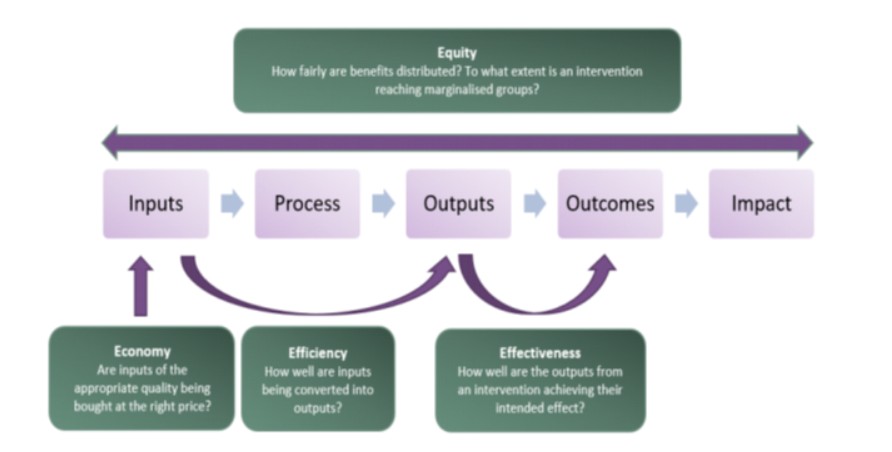
Here is a definition of each term (DFID’s;2014), The National Audit Office’s ‘four Es’ framework – economy, efficiency, effectiveness and equity – is also frequently used to think about different aspects of VfM (Frontier;2022).
• Value for money development should be economic: inputs have been procured at the least cost for the relevant level of quality. For example, in evaluating a training course being delivered in Australia the slightly higher costs for accommodation and flights may be justified given the experience that the cohort requires their own cooking facilities and that flights need to be flexible because participants often change and this leads to more cost in the long run.
Perhaps the simplest method used by CSOs is to design a set of indicators relating to economic (BOND;2012):
- amount of economy savings achieved.
- direct support costs as a proportion of activity spend.
- examples of good procurement practices.
• Value for money development should be efficient: How well do we or our agents convert inputs into outputs? (outputs are results delivered by us or our agents to an external party. We or our agents exercise strong control over the quality and quantity of outputs) (DFID: 2011).
Perhaps the simplest method used by CSOs is to design a set of indicators relating to efficient (Vera Scholz; 2020):
- cost per unit of output.
- cost per direct beneficiary per period.
- budget utilisation rate over reporting period.
• Value for money development should be effective: How well are the outputs from an intervention achieving the desired outcome on poverty reduction? (Note that in contrast to outputs, we or our agents do not exercise direct control over outcomes)
Cost-effectiveness: How much impact on poverty reduction does an intervention achieve relative to the inputs that we or our agents invest in it? (DFID: 2011).
Perhaps the simplest method used by CSOs is to design a set of indicators relating to effective (Vera Scholz ;2020):
- cost for adopting new or improved practices.
- economic return (cost-benefit analysis of separate project components).
- cost per unit of outcome (e.g. job created, child free from disease, etc.).
• Value for money development should be equitable: ensuring that benefits are distributed fairly. For example, a small business incentive program that did not reach the most remote and vulnerable parts of the population may be evaluated as inequitable (Evaluation Matters Third Quarter 2016).
Perhaps the simplest method used by CSOs is to design a set of indicators relating to equitable (Vera Scholz;2020):
- range of marginalised people/groups included.
- cost of increasing participation of marginalised or excluded groups.
- examples of barriers to inclusion being removed.
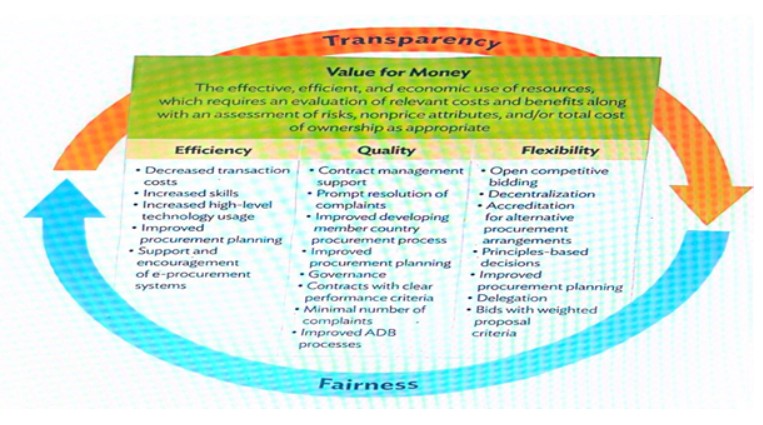
procurement reforms intend to ensure VFM by improving flexibility, quality, and efficiency throughout the procurement cycle (see illustration below). VFM is part of a holistic procurement structure with three support pillars: efficiency, quality, and flexibility. The two key principles of transparency and fairness weave across all elements of the structure.
Figure No. 2
The financial concept of value for money is measured by comparing costs with the benefits or advantages obtained from a product or service (Gould, Marie:2021). This includes looking at the product's quality, durability, functionality, and overall purchasing experience, rather than just the price paid. In the context of evaluating companies or assets, this might include market comparisons, discounted cash flows, or price-to-earnings ratios, or cost-benefit analysis to determine whether the fair value of an asset is comparable to its cost or the value of future cash flows [1, 2, 3, 7].
If you want to ensure that you are making value-based decisions when buying or selling, you can follow these tips to assess value for money:
• Research and compare: Before making a purchase, you should conduct comprehensive research to compare the various options available to you when purchasing a product. You should review all of this data and testimonials to determine the level of satisfaction of previous customers with these products or services.
• Sometimes you need to be aware of long-term costs, as a low initial price can lead to higher long-term costs. For example, devices that may be inexpensive but require more energy or frequent repairs can reduce their effectiveness and increase their long-term costs.
• You can also look for bundled offers and discounts frequently, as some companies offer deals and offers every so often to significantly enhance value for money.
The debate about VfM is in large part driven by the same concerns shaping the discourse about what and how to evaluate development work in general: who is in the driver’s seat when determining what success looks like, how to measure it, and what makes for a ‘good’ or a ‘bad’ intervention? For example (Vera Scholz:2020)
- Should it be funders, technical experts or local voices and interests?
- Are we striking the right balance between investing resources in analysis, learning and reporting vis-a-vis
implementation for beneficiaries?
- How do we deal with programmes that are not easily evaluated?
- How do we measure the VfM of complex interventions that have no pre-defined path to success.
A recent (BetterEvaluation:2025) paper written by Farida Fleming identifies six main methods that can be used to
evaluate value for money. Each approach has benefits and limitations and examines the relationship between
costs and benefits in a particular way:
- Cost Effectiveness Analysis (CE Analysis).
- Cost Utility Analysis (CU Analysis).
- Cost Benefit Analysis.
- Social Return on Investment (SROI).
- Rank correlation of cost vs impact.
- Basic Efficiency Resource Analysis (BER analysis).
The value of money refers to its purchasing power, or the quantity of goods and services that can be obtained with a unit of currency, such as the dinar, for example. It expresses the quantity of goods and services that can be purchased with a unit of currency, As in the examples below:
• Some people, when they want to fit in, want to know what resorts offer them to determine value for money, So when a luxury resort is offered that is more expensive but offers additional amenities for free, It is best to consider those preferences and budget, The luxury resort also offers better value for money in terms of both enjoyment and convenience for these people, despite the higher price.
• If you're buying anew computer, you expect it to be faster and more powerful than your old one. If it isn't, it's not a good value for the money. Value for money is an important factor when making any purchase, especially when making large or expensive purchases.
• Value for money means getting a high-quality product or service at a reasonable price. Here are some other examples of value for money:
- Budget Restaurants:- Fast food restaurants that offer delicious meals at low prices.
- Household products: High-quality, affordable home appliances.
- Services: Public transportation offers low prices and good service.
- Technology: Laptops that offer good performance at low prices.
- Entertainment: Movie theaters that offer great shows at reasonable prices.
- Clothing and Shoes: Brands that offer high-quality clothing and shoes at reasonable prices.
- Travel: Budget hotels that offer comfortable rooms at reasonable prices.
1. Available examples of VfM approaches applied in practice tellingly focus on less complex programmes.
2. VfM might at times be treated as an add-on and at other times as the driving force behind evaluative efforts.
3. Ensuring that a policy or project provides value for money is common sense, particularly at a time of stretched budgets. Yet proving VfM in theory-based evaluations is anything but simple.Benefits can be hard to measure and value; the impact of interventions can be difficult to disentangle in complex, long-running programmes; and the risk of double counting is ever present.
1. It is useful to rely on the concept of value for money and make it a driving force and incentive for individuals and companies to achieve optimal use of available funds.
2. In value for money analysis believes it is worthwhile to ask and investigate whether resources are allocated in the best way possible, But how to do this in each case, and in each evaluation, needs to be informed by more specific questions, resources and audiences. It also needs to take into account the scope for action on evaluation recommendations.
3. There are benefits and limitations to each of the methods of assessing value for money. It is important for the evaluator to consider a range of options for determining whether an activity is value for money. They should think through the benefits and limitations of each approach and ensure key points are included in the design of the evaluation that may be important. It may be necessary for the evaluator to source input from other specialist consultants in particularly complex evaluations of this nature.
4. In order to effectively manage a company, it is important to know how much it is worth. If the organization does not know how much it is worth or what makes good business sense (i.e. acquisitions and mergers), there is a potential to make fatal mistakes that may be detrimental to the organization's well-being.
1. HM Treasury (2022), The Green Book: Central Government Guidance on Appraisal and Evaluation.
2. See https://www.nao.org.uk/successful-commissioning/general-principles/value-for-money/assessing-value-for-money/.
3. DFID’s Approach to Value for Money (VfM).
4. Evaluation Matters Third Quarter 2016 - Value for Money in Development.
5. ACCA. Value for Money (VFM) and performance measurement in not-for-profit organisationsm, 2020.
6. Vera Scholz Contributor(s): Elkhider Mohammed, Beverley Jones, Nigel Simister, VALUE FOR MONEY, 2020.
7. DFID. DFID’s Approach to Value for Money (VfM), 2011.
8. BOND (2012). Value for Money. What it means for UK NGOs.
9. Gould, Marie, Time Value for Money, EBSCO Knowledge, 2021.
10. Australasian Evaluation Society, 6 methods for evaluating value for money, 2025.