By Dr. Sutthi Suntharanurak
By Dr. Sutthi Suntharanurak
State Audit Advisor,

Asian Journal of Government Audit
By Dr. Sutthi Suntharanurak
By Dr. Sutthi Suntharanurak
State Audit Advisor,
In today’s world, procurement is no longer a routine administrative function. It is a strategic lever that determines how governments respond to crises, allocate resources, and maintain public trust. The COVID-19 pandemic, climate emergencies, and supply chain disruptions have exposed the vulnerabilities of existing procurement systems. These disruptions are not merely operational. They are systemic, demanding that public procurement adapt in both mindset and mechanism.
This evolving context is best understood through the lens of the BANI world: Brittle, Anxious, Nonlinear, and Incomprehensible. In such a world, Supreme Audit Institutions (SAIs) must rethink their role. Traditional audits that rely on post-facto reviews and linear checklists are insufficient. Instead, public procurement audits must become anticipatory, adaptive, and capable of safeguarding integrity under complexity and pressure.
This article proposes the 5Vs Audit Criteria—a future-focused audit framework that expands the classical 3Es (Economy, Efficiency, and Effectiveness) and introduces a new language of value, vigilance, and verification for modern public procurement.
The 3Es served the audit profession well in an era of relative stability. However, they offer a limited view when procurement becomes a mechanism for resilience, digital transformation, and social protection. In contrast, the 5Vs framework redefines what SAIs should observe, measure, and influence in the procurement process.
• Value for Money no longer means just cost-saving. Auditors must examine whether procurement decisions generate long-term public value, enhance social equity, and promote sustainability.
• Vigilance calls for proactive risk sensing through real-time analytics. Instead of reacting to fraud or corruption after it happens, SAIs should detect procurement anomalies through AI, data mining, and red flag indicators.
• Velocity focuses on the ability of procurement systems to respond rapidly to public needs—especially during emergencies—while upholding ethical standards. The pace of action must not come at the expense of integrity.
• Visibility demands transparency at every stage. This means more than just publishing contract summaries; it includes using open data platforms, promoting civic tech tools, and fostering participatory oversight.
• Verifiability ensures that all procurement decisions are traceable and documented, enabling both accountability and learning. This is crucial in complex digital environments where procurement may involve algorithmic decision-making.
Figure No. 1
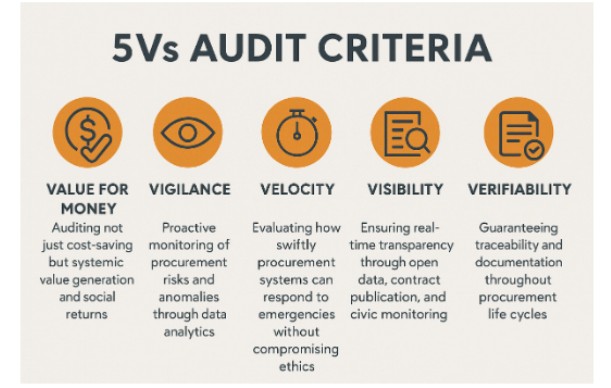
5Vs Audit Criteria for Public Procurement Audit Infographic is created by AI.
Together, the 5Vs do not replace the 3Es—they enhance them. They enable SAIs to audit not only financial compliance but also systemic coherence, ethical soundness, and societal impact.
Auditing in a BANI world is less about predicting outcomes and more about preparing for the unexpected. Each component of the BANI acronym represents a systemic stressor that affects public procurement, and each demands a deliberate audit response.
Brittle systems, marked by fragile supply chains and over-reliance on single vendors, require audits that assess structural resilience. SAIs should examine diversification strategies, redundancy planning, and procurement resilience indicators.
Anxious societies—where public trust in institutions is eroding—necessitate audit communication strategies that go beyond technical language. SAIs must produce clear, engaging reports that resonate with the public and explain how procurement safeguards public interest.
In a nonlinear world, procurement needs shift unpredictably. Traditional audit cycles may be too slow. SAIs should explore scenario-based audit planning and real-time data dashboards to track dynamic risks and priorities.
Finally, the incomprehensible nature of modern digital procurement platforms—integrated with AI, blockchain, and smart contracts—requires auditors to upskill. Algorithmic accountability, digital forensics, and cyber-risk audits are now part of the new audit repertoire.
The lesson is clear: what cannot be understood cannot be audited. SAIs must build capacity to audit emerging systems while collaborating with experts in data science, digital ethics, and procurement innovation.
The future of public procurement auditing lies not in catching mistakes but in designing systems that minimize them. SAIs have a historic opportunity to shift from transactional oversight to transformational leadership. The 5Vs offer a strategic compass for this shift—embedding integrity, adaptability, and systemic foresight into procurement auditing.
As we move deeper into an era of volatility and complexity, auditing must serve not only the rule of law but the resilience of public institutions. Procurement is where policy meets implementation—and where integrity is either upheld or undermined.
By embracing the 5Vs, SAIs can help governments spend not only wisely, but justly and wisely—delivering public value even in the most uncertain times.
“The audit of tomorrow is not about catching errors, but about designing resilient and ethical systems for public value.”