Harshit Todi
Director SAI India

Asian Journal of Government Audit
Harshit Todi
Director SAI India
Public sector governance in the twenty-first century is increasingly characterized by complex policy challenges, inter-ministerial programmes, and multi-stakeholder delivery systems. Governments are investing unprecedented resources in infrastructure, digital platforms, social protection, and environmental initiatives that cut across traditional administrative boundaries. In such a context, traditional silo-based auditing approaches often fall short in capturing systemic risks that arise from interconnected governance structures.
Supreme Audit Institutions (SAIs) therefore face the challenge of evolving their audit methodologies to ensure that accountability mechanisms keep pace with the complexity of public administration. Integrated and cross-cutting audits have emerged as an important tool in this regard. These audits examine policy frameworks, institutions, and operations across multiple entities to assess whether public programmes achieve intended outcomes in an efficient, economical, and effective manner.
This article examines the role of integrated and cross-cutting audits in strengthening public sector accountability. It discusses conceptual foundations, institutional challenges, and presents a case study from India on the audit of “Multi-Modal Transport And Logistics (MMTAL)” initiatives led by Indian Railways.
Public sector accountability has traditionally been viewed through the lens of individual departmental performance. However, as governments shift toward "Whole-of-Government" approaches, addressing complex issues like climate change, logistics integration, urban development, and digital transformation, the mandate for Supreme Audit Institutions (SAIs) must similarly evolve.
SAIs must adopt methodologies that track the flow of resources and data across various legal and administrative boundaries. Integrated and cross-cutting audits represent this new frontier, focusing on outcomes rather than just departmental outputs.
An Integrated Audit combines elements of financial, compliance, and performance auditing into a single oversight exercise. It ensures that the reliability of financial reporting and the efficacy of internal controls are evaluated alongside the economy and efficiency of the program.
A Cross-cutting Audit, conversely, follows a theme or a project across multiple ministries, departments, and even levels of government (Central, State, and Local). It is particularly effective for:
A prime example of this approach is the recent audit of “Multimodal Transport and Logistics” initiatives within the Indian Railways and the broader logistics ecosystem.
Efficient logistics is a critical determinant of economic competitiveness and trade efficiency. In India, logistics systems involve multiple modes of transport—railways, roads, ports, inland waterways, and air cargo. However, these sectors have historically developed in silos, resulting in fragmented planning and operational inefficiencies. While logistics costs for India as a whole stood at 7.97% of GDP in FY 2023-24 1 for long distance, they remain as high as 16.9% for MSMEs, eroding competitiveness and raising inflation, congestion, and emissions. Rail’s freight share declined from 89% in 1951 to 26% in 2025, while road accounts for over 70%, reflecting weak multimodal integration and capacity constraints. Rail freight remains significantly cheaper—₹1.96 per tonne-km compared to
₹3.78 for road 2 - and far cleaner: road transport accounts for 90% of transport-sector CO₂ emissions, while rail contributes only 6% 3.
Government initiatives such as the Unified Logistics Interface Platform (ULIP), PM Gati Shakti National Master Plan and the National Logistics Policy aim to address these challenges by promoting integrated infrastructure development and multimodal connectivity.
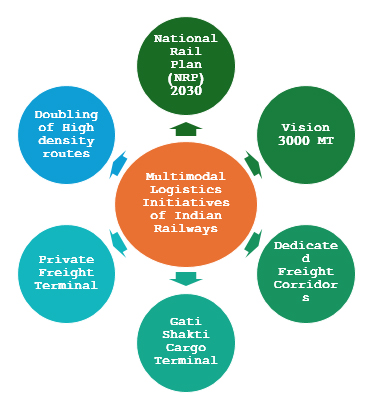
Despite these initiatives, several structural challenges persist:
By virtue of its constitutional mandate, the SAI of India is uniquely positioned to undertake a cross-sectoral, system-level, and forward-looking audit. This is critical in the context of unprecedented public expenditure, multiple concurrent initiatives across ministries, and persistent gaps between policy intent and outcomes.
The audit was designed as a cross-sectoral and inter-departmental exercise, covering the period 2022-23 to 2024-25. Its objectives included assessing:
The audit covered multiple levels of the railway organization—from policy formulation at the Railway Board to implementation at zonal, divisional, and field units. It also examined related entities such as logistics terminals, dedicated freight corridors, and multimodal logistics parks (MMLPs) from both Roadways and Ports sector.
Unlike traditional audits, the Audit Design Matrix (ADM) for a cross-cutting theme must identify "interface risks"—points where the hand-off between two agencies might lead to data loss, financial leakage, or delays. The audit adopted several innovative practices consistent with integrated audit principles.
Although the audit is still evolving, the integrated approach has already generated several important insights:
These findings highlight the value of integrated audits in identifying systemic issues that cut across institutional boundaries.
The experience from this case study offers several lessons for SAIs seeking to adopt cross-cutting audit approaches.
Despite their benefits, integrated and cross-cutting audits face significant hurdles:
multiple offices, since Integrated and cross-cutting audit is new and jurisdiction and conceptual understanding of offices varies. The solution is Integrated Audit Group to oversee such audits.
As we look toward the mid-21st century, the role of the auditor is changing from a "fault-finder" to a "system-evaluator." The case study on the audit of Multi-Modal Transport and Logistics initiatives in India illustrates how such approaches can identify systemic bottlenecks and recommend evidence-based policymaking. Through data-driven analysis, stakeholder engagement, and collaboration with domain experts, the audit demonstrates the potential of integrated methodologies to strengthen accountability and improve governance outcomes.
By sharing such experiences and best practices, SAIs across the ASOSAI region can collectively advance the development of modern, responsive, and impactful public sector auditing systems and thus accountability.
1 DPIIT Report - NCAER study (September 2025)- Assessment of Logistics Cost in India
2 DPIIT Report - NCAER study (September 2025)- Assessment of Logistics Cost in India
3Working Paper on “ Pathways to decarbonize India’s transport sector: Scenario analysis using the Energy Policy Simulator” by WRI India (August 2024).