
Asian Journal of Government Audit
Blue Economy as a Focus Area in the INTOSAI WGEA - SAI India
Introduction
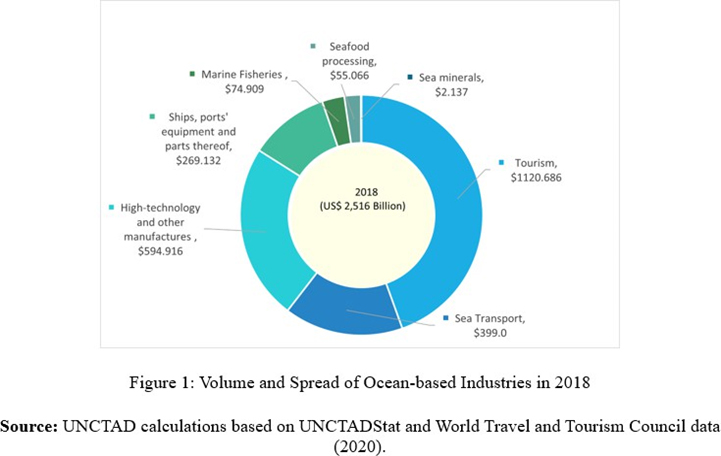
Economic resources around the world are spread over both the land and water areas. Among them, oceans alone cover around 71% of the Earth’s surface, housing 90% of living organisms, providing food security to over three billion people, helping transportation of over 80% global goods and facilitating 98% of global internet traffic through sea-cables (OECD, 2025). The values that oceans bring, therefore, assume importance in the larger context of Blue Economy, which through “sustainable use of oceans’ resources for economic growth, improved livelihood and jobs while preserving the health of the ecosystem” balances different aspects of economy, livelihood and environment (World Bank, 2017). An UNCTAD report (2021) estimated the export value in ocean-based industries, spreading over several sectors, at $2.5 trillion (UNCTAD, 2021), as shown in Figure 1 below.
SDG 14 and Co-benefits of Achievements under SDG-14
United Nations, recognising the importance of ocean economy and environment, adopted in 2015, Sustainable Development Goal (SDG) 14 as one of the 17 SDGs, to ‘conserve and sustainably use the oceans, seas and marine resources for sustainable development’. A 2020 study by Johansen and Vestvik had estimated that around $175 billions of funding would be required every year until 2030 for achievement of targets under SDG-14. However, in the period between 2015-19, only $10 billion had been provided (WEF, 2022). Of the 17 SDGs outlined by the United Nations 2030 Agenda in 2015, the ocean goal is the least funded (WEF, 2022).
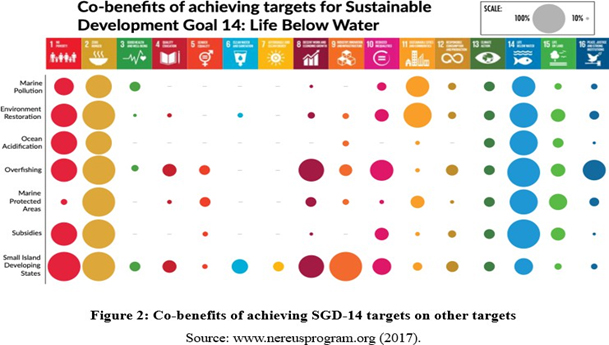
Preventing and significantly reducing marine pollution of all kinds; sustainably managing and protecting marine and coastal ecosystems to avoid significant adverse impacts; minimising and addressing the impacts of ocean acidification; effectively regulating harvesting and ending overfishing; conserving coastal and marine areas; prohibiting fisheries subsidies which contribute to overcapacity and overfishing; increasing the economic benefits to Small Island Developing States (SIDS) and least developed countries from the sustainable use of marine resources, including through sustainable management of fisheries, aquaculture and tourism, etc. are some of the targets set under the SDG 14 (United Nations, n.d.). Based on scientific expert consultation, a 2017 study of Nippon Foundation-Nereus Program developed linkages between progress in each of the above target and co-benefits with other SDGs, showing all-pervading influence of coastal, marine and ocean resources across different SDGs (Figure 2).
Blue Economy in the Indian Context
In India, Blue Economy has assumed enhanced focus in the policy parlance in recent times. The Draft Policy on India’s Blue Economy, along-with the reports of seven Working Groups on different sectors of the Blue Economy, released by the Prime Minister’s Economic Advisory Council (2020) provided a comprehensive framework for the important Blue Economy sectors. SAI India during its SAI20 Chair tenure in 2023 chose Blue Economy as a key focus area. There have been further developments in studying different aspects of Blue Economy, especially after the High Seas Treaty was agreed upon in 2023.
NITI Aayog in its recent report (2025) titled, “India’s Blue Economy: Strategy for Harnessing Deep-Sea and Offshore Fisheries” highlighted the need for infrastructure development, monitoring, control and surveillance to explore these relatively unexplored areas. Ministry of Earth Sciences (2025), in its recent report titled, “Transforming India’s blue economy: Investment, innovation and sustainable growth” emphasised the need for a strategic investment roadmap to 2035, highlighting short-, medium- and long-term priorities across sectors and systems with need, inter alia, for improving coordination between ministries and institutions, attracting more private and global investment, and scaling successful and replicable state and local models. Turning Marine waste to value, through waste management is also emerging as an economically valuable and environmentally sustainable proposition (Poornima, V.B., 2026). In its 2025 study, KPMG identified sectors like fisheries, tourism and maritime activities driving India’s Blue Economy and future opportunities in sectors like renewable energy, sustainable aquaculture, coastal development and marine biotechnology, to make considerable progress in food security, health, climate change mitigation and achieving sustainable development.
Selection of Blue Economy as a Focus Area under the INTOSAI WGEA
It is in the above context, SAI India during the ongoing Work Plan 2026-28 has chosen to lead the Project on Blue Economy, with two main goals, i.e. to develop guidance on conducting environmental audits of Blue Economy, and to focus on emerging areas, innovative methodologies, and effective reporting while auditing Blue Economy sectors. As a part of this Project, SAI India in collaboration with other SAIs, would develop a Guidance Document on conducting environmental audits of the Blue Economy. The Guidance Document will focus on emerging areas under the broad themes of Blue Economy while leveraging innovative methodologies. Since Blue Economy sectors are multifaceted, it would be unwieldy to approach all of them from a single yardstick. Thus, SAI India conducted a detailed survey amongst some of its related field audit offices. Based on the responses to the survey, literature review and extensive deliberations, SAI India identified the following four probable themes to seek suggestions of INTOSAI WGEA members to focus on any one or two themes:
- Fisheries and aquaculture
- Coastal and marine tourism
- Coastal and marine pollution and waste management
- Coastal zone ecosystem management
It was decided that to carry out the project focussing on any one theme, willingness of at least three members would be required for the same, with a cap of maximum six SAIs under each selected theme. SAI India sought views, willingness and suggestions of other members of INTOSAI WGEA by the end of 2025, to take the Project forward. SAIs of Thailand, Vietnam, Zambia, Oman and Algeria expressed their willingness to join the theme on ‘Coastal and marine pollution and waste management’ while SAIs of Thailand, Vietnam, Bulgaria and Algeria expressed willingness to join the theme on ‘Coastal zone ecosystem management’. Therefore, these two themes have been selected for development of detailed guidelines for audit. The detailed guidance on the selected theme would include guidance on audit planning, evidence gathering, analysis, structure and content recommendations for audit reports, along-with documentation of training needs and knowledge gaps, to suggest appropriate training on the selected themes. The Project will be also guided by the spirit of leveraging cutting-edge technology along-with traditional auditing methods. The use and analysis of big-data, geo-spatial data, remote sensing and drone technologies, AI-ML Learning Applications will showcase the utility of these new-age technologies for auditors.
The development of the Guidance Document would follow a Level 1 Quality Assurance Procedure as prescribed for non-IFPP documents by INTOSAI and would require approval of the INTOSAI Goals Committee or designated approval body at three stages: at the stage of detailed project proposal, exposure draft and final endorsement version. Therefore, the quality of the document would be quite robust by its standard.
Conclusion
Deep-rooted significance of Blue Economy in the national and global economy and interconnection of SDG 14 with the achievement of many other SDGs, necessitate that SAI community delve deeper into auditing multiple themes of the Blue Economy and ocean resources. Development of a Blue Economy Audit Guideline, led by SAI India, would be the first of its kind and a significant pointer for Audit from the Footnote in prepsective 1. Taking up two themes under the Work Plan 2026-‘28, i.e., ‘Coastal and marine pollution and waste management’ and ‘Coastal zone ecosystem management’, along-with a backdrop on how audit of Blue Economy should be approached in totality while leveraging new age technologies would help this Guidance Document establish its relevance to the INTOSAI community in the rapidly changing auditing landscape.
1 Development of a Guidance document on “Auditing Sustainable Fisheries Management” was done by the SAI of South Africa in 2010, along-with other SAI members in the team.
References:
- Economic Advisory Council to the Prime Minister. (2020, September). India's blue economy: A draft policy framework. Government of India.
https://incois.gov.in/documents/Reports/Others/Report_2020_20251023100635.pdf
- KPMG. (2025, July). Navigating India’s blue economy landscape: Tapping the tide of innovation and transformation. https://assets.kpmg.com/content/dam/kpmgsites/in/pdf/2025/07/navigatingindiasblueeconomylandscape.pdf
- MoES (2025), Transforming India’s blue economy: Investment, innovation and sustainable growth. EY.
https://www.moes.gov.in/static/uploads/2025/09/2002f7a328184b9203f70b5dc15c4f17.pdf Accessed 08 March 2026.
- Nippon Foundation-Nereus Program (2017), Oceans and Sustainable Development Goals: Co-benefit, Climate Change and Social Equity, Vancouver, p.28, www.nereusprogram.org (2017).
- NITI Aayog. (2025). India's blue economy: Strategy for harnessing deep-sea and offshore fisheries.
https://niti.gov.in/sites/default/files/2025-10/IndiasBlueEconomyStrategy ForHarnessingDeepSeaAndOffshoreFisheries.pdf
- OECD (2025), The Ocean Economy to 2050, OECD Publishing, Paris, https://doi.org/10.1787/a9096fb1en https://www.oecd.org/en/publications/theoceaneconomyto2050a9096fb1en.html
- UNCTAD (2021), Ocean economy offers a $2.5 trillion export opportunity: UNCTAD report, https://unctad.org/news/oceaneconomyoffers25trillionexportopportunityunctadreport, accessed 10 March 2026.
- United Nations. (n.d.). Goal 14: Life below water. https://www.un.org/sustainabledevelopment/oceans/
https://www3.weforum.org/docs/WEF_Tracking_Investment_in_and_Progress_Toward_SDG14.pdf accessed on 09 March 2026.
10. World Bank (2017), What is the Blue Economy?, World Bank group, https://www.worldbank.org/en/news/infographic/2017/06/06/blueeconomy , accessed 10 March 2026.
******END******